
For this one I bought a new bit. Its a tapered ball nose end mill with a 0.5mm tip, and is typical for detailed carving on a CNC machine.
Cutting is done in two passes: one roughing pass typically using a flat end mill (although I used a 1/4″ round), and then a detail pass using this ball nose end mill. The finishing pass is done as one complete pass in raster mode, rather than layer by layer which is typical for roughing. This means the Z axis is doing a lot of up and down motion as the X axis goes back and forth across the piece, with the Y axis making tiny increments for each raster pass. This works fine as long as the depth of cut is not greater than the cutting depth of the ball nose end mill, which is a little over an inch. My depth of cut was less than 1/2 inch.
I used a clip art pattern from the VCarve software. The workpiece size was 80mm x 100mm (i.e. not very big). Even so, the final pass takes over 5 hours! I didn’t have the patience to wait, and stopped it after 1.5 hours, but that’s OK because I did achieve my goal of figuring out how this thing works. The long run time is due to the small overlap of 4%, which was the default setting. This means the Y axis increments by 4% of 0.5 mm for each pass of the raster scan, which works out to 50 passes per millimeter.
The overlay value allows you to make a tradeoff between carving time and smoothness. I read that if a 10% overlay is used, lines can show in the workpiece, which is not desired and will ruin a piece like this. Even using 4% overlap, lines can be seen if you examine the piece very closely under magnification, but these aren’t visible to the eye.
Another tradeoff is the radius of the end mill. A radius of 1 mm might be worth trying (instead of 0.5 mm that I used), which would cut the run time in half.
Here’s the result:
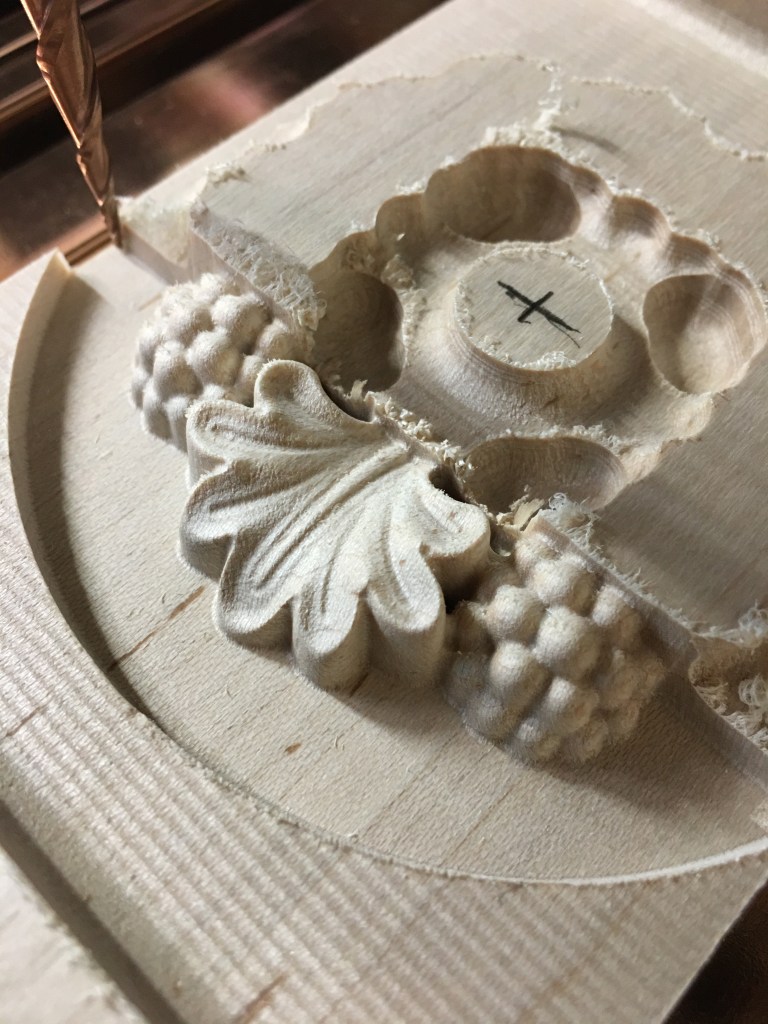
The results look very good to me. The details of the leaf and ball clusters are quite fine. Now, I’ve done some manual woodcarving in the past, so seeing that leaf with no undercut looks very odd, but that’s the nature of a CNC machine. To be fair, I was never skilled enough to create a piece like this in the first place, so I guess I shouldn’t complain!
The wood is soft maple. I like how clean the finish cut looks on the flat plane, and around the circular edge. Based on what I’ve seen so far, that tapered ball nose bit works well, and I have no complaints. It spun at 18000 RPM, which is faster than I typically use for roughing (12000). And at ~$17, this is a good value especially compared with other manufacturers who sell a similar bit in the $50 to $70 range.
 howardpinder.com