Using the HVACmon function, I noticed something strange happening on the upstairs A/C unit at night. Here’s the graph:

This shows 3 days of history. Notice the Upstairs A/C unit (labeled “Up”), and how in the evening and at night there are large blocks of green, representing long periods of A/C usage.
This was interesting, because at the same time, the sleepers in the house were complaining of sometimes being too hot, and sometimes too cold. We couldn’t find a thermostat setting that was comfortable. What’s going on here?
After some research I found out the Nest uses a “swing” of 1 degree. That means if the thermostat is set at 72, it won’t turn on the A/C until the temperature reaches 73 and won’t turn off until it goes down to 71. This results in a 2 degree differential, and it was causing my issue! It turns out this is a well-known issue with Nest. Many people complain about it, and there’s even a company that sells a cloud service to work around the issue! C’mon Nest, fix it already!
Anyway, in order to confirm what I was seeing, I bought a Zwave temperature sensor, put it in the bedroom, and started collecting data (using HA of course). Using this setup I quickly confirmed we were experiencing a temperature differential in the room of over 2.5 degrees!
I replaced the Nests with Radio Thermostat CT-101 units, which I bought “open box” for around $35 each. These thermostats have an adjustable “swing” setting, and as a bonus can be controlled via Zwave (using Home Assistant of course). I set the swing to 0.5 degree, and the temperature differentials got much better:
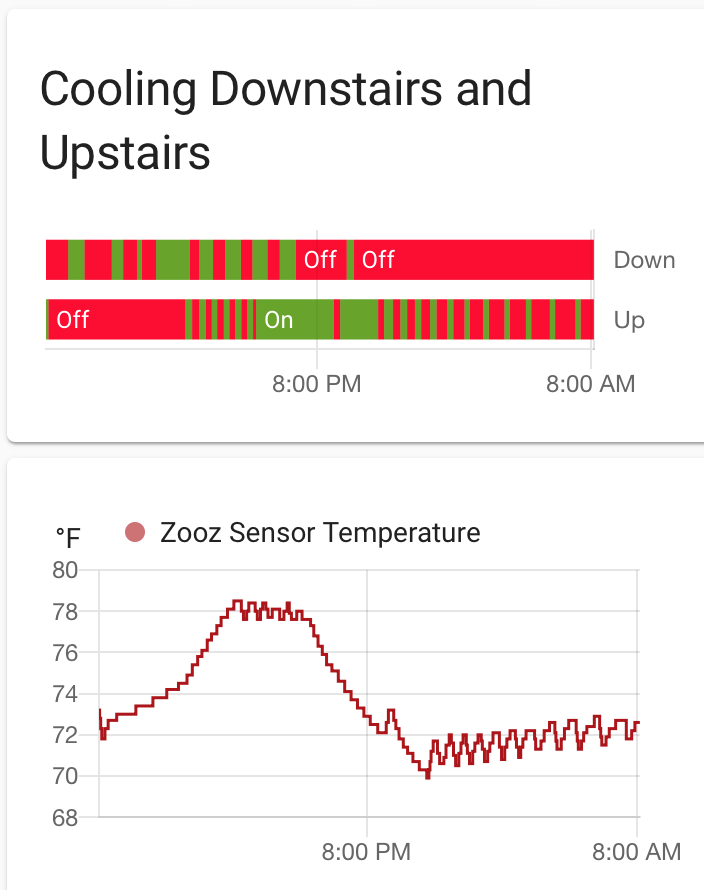
Notice at night the upstairs A/C is running for shorter bursts. This is how you want A/C to run, for around 12 to 18 minutes at a time, once or several times per hour. The temperature measurements are much more stable, with a differential of around 1.5 degrees as measured in the room. This might not seem like much of a difference (1.5 vs 2.5 degrees of differential) but let me tell you, it makes a world of difference in sleeping comfort!
I’m happy to say that Home Assistant helped me recognize, diagnose, and ultimately solve an A/C issue in my home.
 howardpinder.com
I know this was someone’s favorite project.
LikeLike